Quick answer: answer one question before you shop, because it decides everything else. If your heat pump blows through ducts, the ecobee Smart Thermostat Premium is the pick, since it wires to the O/B reversing valve and lets you cap how eagerly the electric aux strips fire. If you have ductless mini-split heads, no wired thermostat can touch them at all: the Mysa Smart Thermostat replaces the handheld remote with a real wall unit, and the Sensibo Air does the same job for less if you are content running everything from your phone.
Bottom Line
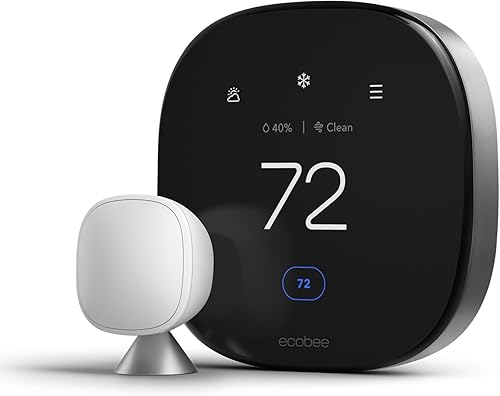
ecobee Smart Thermostat Premium
This is the one to buy if your heat pump feeds ductwork. It handles the O/B reversing valve and multiple stages of auxiliary heat, reports how many hours those expensive resistance strips actually ran, and includes a room SmartSensor so the far bedroom gets a vote. Siri, Alexa, and Google Assistant all work with it, and the bundled Power Extender Kit solves a missing C-wire at the air handler. Its verified-buyer average sits at 4.4 stars.
See ecobee Premium →Mysa Smart Thermostat
Mini-split heads have no thermostat wire to tap, so this one talks to the head over infrared exactly as the handheld remote does, then wraps schedules, geofencing, and voice control around it. What separates it from cheaper controllers is that it is a genuine wall unit with a display you can read and adjust without unlocking a phone, which matters in a household where not everyone runs the app. Works with HomeKit, Alexa, and Google Home, and charges nothing monthly.
See Mysa →Sensibo Air
The same infrared trick for less money, and it installs in roughly a minute: plug it in, point it at the head, let it learn your remote's code set. It is Apple HomeKit certified, so Home app tiles and Siri work natively rather than through a bridge. The catch is that the hardware has no buttons or dial, so every adjustment goes through the app or a voice assistant.
See Sensibo Air →Three picks, but really two decisions. The rest of this page is about why the ducted and ductless answers are not interchangeable, and how to keep a heat pump from quietly heating your house with resistance coils all winter.
Why a Heat Pump Changes the Thermostat Math
A gas furnace has one job: burn fuel until the room hits the number. A heat pump has two modes running through the same outdoor unit, plus a backup heat source that costs far more to operate than the primary one. The thermostat sits in the middle of that arrangement, and picking the wrong one shows up on the utility bill rather than on the wall.
Two wiring facts drive the ducted side. First, the O/B terminal commands the reversing valve, the component that decides whether the outdoor coil is collecting heat or dumping it. A thermostat built for conventional furnace and air-conditioner wiring has no such terminal, so it physically cannot tell the system which way to run. Second, the auxiliary and emergency heat terminals control electric resistance strips in the air handler. Those strips are effectively a giant toaster: they produce heat at roughly one unit out per unit of electricity in, where the compressor in mild weather can deliver two or three. Anything that makes the strips run more than necessary is money burned.
This is where the furnace habit of a deep overnight setback backfires. Drop the target ten degrees at bedtime and the morning recovery is too large for the compressor to satisfy on its own, so the thermostat brings the strips in to catch up. You saved a little overnight and then paid it back several times over at 6 a.m. Heat pumps reward the opposite behavior: shallow setbacks of a degree or two, and long steady low-output runtimes.
The ductless side has no wiring conversation at all. A mini-split head receives commands by infrared from the handheld remote and has no thermostat terminals to intercept, which is why a wall thermostat cannot control one no matter how capable it is. If you are still deciding between system types, or shopping for a conventional furnace instead, our wider roundup of smart thermostats covers the ducted furnace and air-conditioner picks that do not apply here.
The Three Compared
Note the first row. It is not a preference, it is a compatibility gate, and it rules out two of these three products for any given house.
| Feature | ecobee Premium | Mysa | Sensibo Air |
|---|---|---|---|
| System type | Ducted heat pump (wired) | Ductless mini-split (infrared) | Ductless mini-split (infrared) |
| Price | $$$ | $$ | $$ |
| Controls reversing valve (O/B) | Yes, wired | Not applicable, head handles mode | Not applicable, head handles mode |
| Aux / emergency heat staging | Yes, with runtime reporting | Not applicable | Not applicable |
| Physical controls on the unit | Touchscreen | On-unit display and controls | App only, no buttons or dial |
| Apple HomeKit / Siri | Yes | Yes | Yes, HomeKit certified |
| Alexa | Yes, with onboard speaker and mic | Yes | Yes |
| Google Home | Yes | Yes | Yes |
| Room sensor in the box | Yes, one SmartSensor | No | No, sold separately |
| Works without a C-wire | Yes, Power Extender Kit included | Not applicable, plug-in powered | Not applicable, plug-in powered |
| Subscription required | No | No | No, optional paid tiers exist |
| Geofencing | Yes | Yes | Yes |
Price tiers are approximate. $ = under $50, $$ = $50 to 150, $$$ = $150 to 300, $$$$ = over $300. Tap any link for the current Amazon price.
The ecobee row full of yes answers is not evidence that it is the better product. It is a different category of product, and it is worth nothing at all in a house with mini-split heads on the wall.
The Setting That Actually Saves You Money
On a ducted system, the single most valuable control is the one governing when auxiliary heat is permitted to run. It usually appears as a compressor lockout temperature, an aux differential, or both. The differential says how many degrees the room is allowed to fall behind the target before the strips join in; the lockout says how cold it has to be outside before the compressor is considered incapable on its own.
Factory defaults tend to be conservative because a manufacturer would rather field complaints about a power bill than complaints about a cold house. Widening the differential slightly, so the system tolerates being a degree or two behind during recovery, keeps the compressor doing the work it is good at. The ecobee exposes these settings under its installer options and, more usefully, reports aux runtime in its energy history, so you can see the effect of a change rather than guess at it.
That runtime report has a diagnostic use too. Auxiliary heat in genuinely cold weather is the system working as designed. Auxiliary heat piling up in mild weather is a signal: low refrigerant charge, a defrost cycle that is not terminating properly, or a reversing valve that is sticking. The thermostat is not the fault in that case, but it is the instrument that tells you to call someone before the strips run all season.
Mini-split owners do not have this dial, and mostly do not need it. The inverter-driven head modulates its own output continuously and has no resistance backup to protect you from. What an infrared controller adds is scheduling and geofencing for a head that otherwise only obeys whoever is holding the remote, plus the ability to fold heating into the rest of a connected home. If you are building that side out, the same logic applies to plugs that meter what a circuit actually draws, which is a cheap way to confirm where the winter electricity is going.
What Owners Report After a Winter
Thermostat complaints cluster in two places: installation, and what happens the first time the weather turns. The paraphrased themes below come from verified-buyer feedback across the three listings.
ecobee Smart Thermostat Premium: 4.4-star verified-buyer average
Owners consistently describe the Power Extender Kit as the reason the install succeeded, since a great many older thermostat walls have no C-wire and the alternative is running new cable. Heat pump owners specifically call out the aux runtime history as the feature that changed their behavior, several reporting that they abandoned deep setbacks after seeing the strip hours. The recurring criticism is the sheer depth of the settings menus, with buyers noting that the options controlling heat pump behavior sit several layers down and are easy to miss entirely.
Mysa Smart Thermostat for mini-splits
The theme owners return to is that the household stopped hunting for the remote. Buyers with heads in bedrooms and additions describe setup as straightforward once the correct remote code set is matched, and value having a wall unit that guests and family members can operate without being handed a phone. The complaint worth planning around is line of sight: the controller has to be able to see the indoor head to transmit, so a placement behind a door or across a corner can produce commands that do not land.
Sensibo Air
Owners describe the installation as close to trivial and the HomeKit integration as the reason they chose it over cheaper generic controllers. The two persistent criticisms are related to each other: there are no physical controls on the device, so a dead phone battery or a fussy app update leaves you back at the handheld remote, and buyers report friction around the prompts for the paid subscription tiers layered over features they expected to be included. The core scheduling and remote control do work without paying.
Jacob’s read on this category
The install gotcha nobody warns you about on the ductless side is line of sight. An infrared controller is a remote in a nicer box: if it cannot see the head, nothing happens, and the failure is silent because the app cheerfully reports the command as sent. Before you commit to a spot on the wall, stand there and aim the handheld remote at the head from that exact position. If the head beeps, the controller will work there. Skip that thirty-second test and you may find yourself drilling a second set of holes. On the ducted side, my one rule is to open the aux heat settings the same day you install, not in January when the bill arrives.
Which One Fits Your House
Start with the equipment, not the feature list. The right answer is usually obvious once you have identified what is actually installed.
Frequently Asked Questions
How We Put This Together
Heat pump thermostat guides usually fail in the same way: they list wall thermostats and never mention that a mini-split cannot use one. We split the field by control method first, then checked each product against its manufacturer specification for the traits that decide compatibility, the O/B reversing valve terminal, auxiliary heat staging, infrared code learning, and power source. Voice assistant and HomeKit support were confirmed per product rather than assumed from the brand. Star ratings quoted above were read from the live Amazon listing during this update on 2026-08-20; where we could not confirm a current rating for a listing we describe owner sentiment instead of quoting a figure. Head-to-head thermostat feature detail lives in our Ecobee and Nest Learning comparison. Aux-heat and wiring claims for the top pick were checked on ecobee's Smart Thermostat Premium page, and the heat pump efficiency context comes from ENERGY STAR's air-source heat pump guidance.
We take no payment from ecobee, Mysa, Sensibo, or any brand named here. If you spot an error, please let us know.
Prices and availability reflect Amazon listings at time of writing. Confirm on the product page before purchase.