Quick answer: this choice is about how much porch you are trying to watch. Watching a long walkway, a driveway, or anything you will want to zoom into later? Take the Ring Battery Doorbell Pro for its 4K frame and radar-based 3D Motion Detection. Watching a small stoop where the only question is who is at the door? The Ring Battery Doorbell Plus gives you the same app and the same alerts at a lower price, and its quick-release battery is the better daily-living feature.
Bottom Line
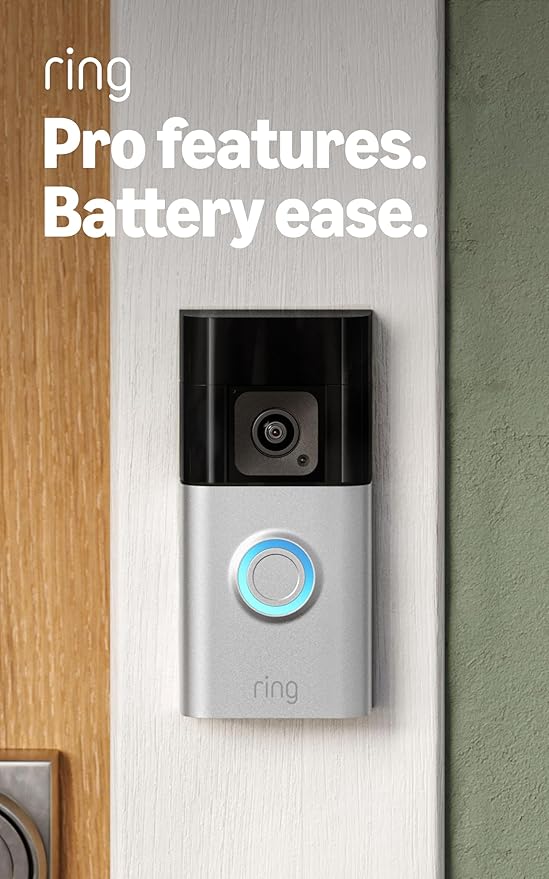
Detection Range & Detail
The Pro earns its premium in two situations: a camera that has to see past the mat, and footage you intend to crop into afterwards. Radar ranging cuts alerts from the sidewalk, Bird's Eye View draws the path a visitor walked, and the 4K frame survives a 10x zoom. On a short stoop, none of that changes your day.
See Battery Doorbell Pro →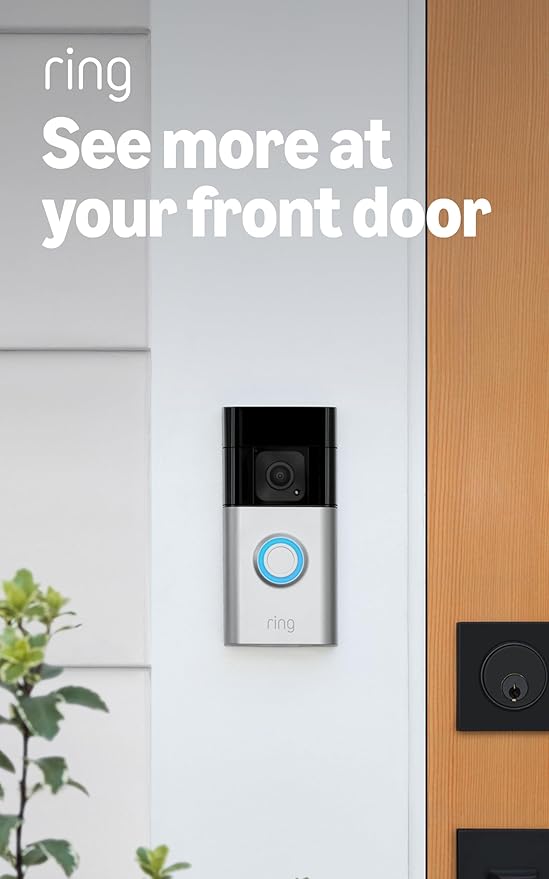
Value & Daily Convenience
Retinal 2K at roughly 140 degrees by 140 degrees is plenty to identify a face and read whether a parcel was left or taken. The included quick-release battery pack means recharging is a swap at the door, not an afternoon with a hole in your coverage. Most doors do not need more than this.
See Battery Doorbell Plus →App, Alexa & Subscription
Identical Ring app, identical Alexa and Echo Show behaviour, identical Ring Home plan tiers, identical hardwire option, identical lack of a microSD slot. Anyone choosing between these two on software or ecosystem grounds is choosing on a difference that does not exist.
So the decision comes down to the sensor package and the picture. Here is where each one actually lands.
Pro vs Plus, Spec by Spec
Every row below reflects the two listings we link on this page. Where Ring's own documentation and older retailer copy disagreed, we deferred to Ring's current support page and left the cell qualitative rather than guessing a number.
| Spec | Battery Doorbell Pro | Battery Doorbell Plus |
|---|---|---|
| Video | Retinal 4K, wide-angle | Retinal 2K, head-to-toe |
| Field of view | Wide-angle head-to-toe (check listing for figures) | 140° x 140° (178° diagonal), 5° downward tilt |
| Motion detection | 3D Motion Detection (radar ranging) plus motion zones | Camera-based motion zones |
| Bird's Eye View path mapping | Yes (needs the radar sensor) | Not available without radar |
| Zoom | Up to 10x Enhanced Zoom | Digital zoom (check listing) |
| Power | Removable battery pack; hardwire-capable | Included Quick Release Battery Pack; hardwire-capable |
| Voice assistant | Alexa, with live view on Echo Show | Alexa, with live view on Echo Show |
| Local recording | Via a Ring Alarm Pro base station (sold separately) | Via a Ring Alarm Pro base station (sold separately) |
| Saved video history | Paid Ring Home plan required | Paid Ring Home plan required |
| Price | $$$ | $$$ |
Price tiers are approximate. $ = under $50, $$ = $50 to 150, $$$ = $150 to 300, $$$$ = over $300. Tap any link for the current Amazon price.
Both sit in the same tier bracket, which is the part most comparisons gloss over. The Pro is the dearer of the two, but not by a bracket, so this is not a budget-versus-premium decision. It is a question of whether the radar and the extra pixels do anything on your specific porch.
What the Radar Sensor Actually Buys You
A normal battery doorbell decides something moved. The Pro's 3D Motion Detection decides something moved and how far away it was, because radar returns a distance rather than a heat signature. That distinction is the whole argument for the Pro.
If your front door opens onto a pavement, a shared driveway, or a street with parked cars, a conventional sensor fires on every passer-by inside its cone, and you learn to ignore the notification. Distance-aware detection lets you draw the cutoff in metres instead of in vague zone shapes, which is the difference between an alert that means something and a phone you mute.
Bird's Eye View rides on the same sensor. It plots the route a visitor took across the detection area and shows it as an overhead trace, so a review session tells you where someone walked, not only that they appeared. It is genuinely useful for working out whether a van driver walked up to the door or lingered by the cars, and it is the one Pro feature with no equivalent on the Plus at any setting.
The honest caveat: radar does not help a stoop. If the sensor's whole field is three metres of brick and a doormat, there is nothing to range and nothing to map. Readers in flats and terraces usually find the Plus does everything the Pro does, which is also the pattern we see across the lineup in our roundup of this year's video doorbells.
4K Versus 2K, and When the Difference Shows
Resolution arguments get silly fast, so here is the practical version. At the distance a visitor stands to press a doorbell, 2K already resolves a face clearly enough to recognise someone you know and describe someone you do not. Going to 4K changes nothing about that framing.
Where 4K earns its keep is cropping. The Pro pairs its sensor with up to 10x Enhanced Zoom, and the zoom is only as good as the pixels underneath it. Pull in on a number plate at the kerb or a courier's label on a box, and the 4K frame holds legible detail where a 2K frame breaks into blocks. If you have ever tried to read something back from doorbell footage and failed, that is the feature you were missing.
The Plus answers a different question well. Its roughly square 140 by 140 degree field with a slight downward tilt is built to show a visitor head to toe and the ground immediately in front of the door, which is exactly the frame you want for parcel confirmation. Taller framing beats a wider panorama on a small porch, because the thing you need to see is usually on the floor.
One shared constraint worth planning for: Ring recommends a decent upload speed for its 2K devices, and a 4K stream asks for more again. A doorbell sitting at the far edge of your Wi-Fi, behind a brick wall and a metal door frame, will drop to a worse picture than its spec sheet promises regardless of which model you bought. Fix the signal before you pay for pixels.
The Battery Detail Nobody Mentions Until Month Two
Both doorbells run on a removable battery pack and both can be wired to existing doorbell wiring if the transformer meets Ring's voltage and wattage requirements. That hardwire option is the single best upgrade either model can get, and it is free if the wires are already in the wall.
If you are staying on battery, the Plus ships with a Quick Release Battery Pack, and Ring sells a higher-capacity Quick Release Ultra pack that fits it. The practical upshot is a workflow, not a spec: buy one spare pack, keep it charged indoors, and a recharge becomes a thirty-second swap at the door rather than several hours with your doorbell on the kitchen counter and your porch unwatched. Coverage gaps during charging are the complaint that drives people off battery doorbells, and a spare pack removes it entirely.
Expect the Pro to drain faster in like-for-like conditions. A 4K pipeline and an active radar sensor both cost power, and radar runs continuously rather than waking on heat. On a busy front door that mostly means more frequent recharges, which is another argument for hardwiring the Pro specifically. Cold weather makes it worse for both; lithium cells lose usable capacity below freezing, so a winter porch in a northern climate is a hardwire candidate whichever model you choose.
Subscription, Storage and the Thing to Check First
Neither doorbell saves video without a paid Ring Home plan. Without one you get a live view and a motion notification, which tells you nothing about what happened while you were at work. The plan tiers, the saved history window, and the smarter search features are the same for both doorbells, so the subscription is not a tiebreaker here, it is a shared running cost to budget for before you buy either.
Local storage deserves a straight answer: neither of these has a microSD slot. Recording to your own hardware on the Ring platform means adding a Ring Alarm Pro base station, which is a separate purchase, so it is an upgrade path rather than something the doorbell does out of the box. Anyone whose main goal is avoiding a monthly fee should start from our guide to doorbells that work without a subscription instead of either model on this page, because no Ring configuration gets you there cheaply.
Cross-brand shoppers have one more comparison worth reading: the trade-off against Google's doorbell is a different shape again, with free local-ish history on one side and Alexa depth on the other, which we unpack in Nest versus Ring.
What Owners Keep Reporting
Aggregated owner feedback on both doorbells, read as themes rather than individual verdicts, lines up tightly and is worth more than either spec sheet.
On the Pro, the recurring positive is alert quality: owners describe a clear drop in pointless notifications once the distance threshold is tuned, and several describe Bird's Eye View as the feature they did not expect to use and now check first. The recurring complaint is battery life on high-traffic doors, usually from people who did not hardwire.
On the Plus, the common thread is that the picture and the framing are better than buyers expected at the price, with parcel visibility called out repeatedly. The complaints cluster around motion sensitivity on open frontages, which is the exact failure mode the Pro's radar addresses, and around Wi-Fi reach at the door rather than the doorbell itself.
Across both, the install feedback is consistent: mounting is a two-screw bracket and a wedge, under fifteen minutes, no electrical knowledge needed on battery. Hardwiring is where owners report friction, mostly older transformers that do not meet the requirement.
Which One Should You Buy?
Buy the Battery Doorbell Pro if your door faces a path, a driveway, or a street, if you have ever been annoyed by alerts for people who never came near the house, or if you want footage you can crop into later and still read. Hardwire it if you can.
Buy the Battery Doorbell Plus if your doorbell watches a short stoop or a shared hallway, if parcel confirmation is the main job, or if you would rather put the saved money toward a spare quick-release battery and a year of the plan you will need anyway.
Buy neither if avoiding a monthly subscription is your priority. Both Ring doorbells need a plan to be useful after the fact, and no amount of hardware spend changes that.
Prices and availability reflect Amazon listings at time of writing. Confirm on the product page before purchase.
Frequently Asked Questions
How This Matchup Was Put Together
Both doorbells here were already covered on this site, so the ASINs linked above were checked against the products we had previously verified rather than taken from memory. Specs were then re-read this run: Ring's own current support documentation for the Plus (resolution, field of view, battery pack, hardwire requirements) and launch and spec coverage for the Pro's radar sensor, Bird's Eye View and zoom. Where sources conflicted, older retailer copy describing an earlier generation was discarded and the cell was left qualitative instead of printing a figure we could not stand behind. Listing data was re-checked on 2026-10-08.
No payment was taken from Ring or any brand named here. Spotted something wrong? Please let us know.